Charging from a condo garage is the normal case in Miami, not the exception
Start with the garage, because that is where a large share of Miami cars park. Towers in Brickell, Edgewater, Aventura and Sunny Isles Beach assign each unit a space, run power through shared electrical rooms, and control changes through a board and a building engineer. Adding a charger there is part electrical job and part building project. The run from the electrical room to your space may cross ceilings, fire-rated walls and other owners spaces, and the building panel may serve hundreds of units.
That setting rewards a phased plan. One owner adding one circuit is a metering and routing question. Ten owners asking in the same year is a capacity question, and the board may prefer a shared system with load sharing and per-driver billing over ten separate long runs. If you are the first owner in your building to ask, expect the process to take longer, because the board is setting a pattern for everyone after you.
Single-family streets tell a different story. In Coconut Grove, Pinecrest, Cutler Bay and Hialeah, the charger usually lands in a garage or on an exterior wall near the driveway, the panel is inside the same house, and no board vote stands in the way. The challenges there are weather and distance, not governance. Keeping those two tracks separate — garage towers versus houses — will save you from advice written for the wrong building.
What does Florida Statute 718.113(8) actually give a condo owner?
Florida law gives condominium owners a specific protection that homeowners in a planned community do not automatically share. Under Section 718.113(8), Florida Statutes, a declaration of condominium or restrictive covenant may not prohibit, and a board may not deny, a unit owner who wants to install a charging station inside their limited common element or exclusively designated parking area, as long as the work follows the statute.
The right comes with duties, and boards are allowed to enforce them. The electricity for your station must be separately metered, or measured by an embedded meter, and paid for by you or your successor. You pay for installation, operation, maintenance and repair, and for removal if the station is later taken out. The association can require work that meets building codes, follows reasonable architectural standards, uses licensed contractors familiar with this kind of install, and carries hazard and liability insurance naming the association as an additional insured. If your station raises the association insurance cost, you reimburse that increase. The installation also may not cause irreparable damage to the condominium property, and the statute provides an implied easement across common elements so power can reach your space.
A split inside Florida law
That protection sits in Chapter 718, the condominium act. Chapter 720, which governs homeowners associations for single-family planned communities, contains no matching charging provision. So a condo owner in a tower and a house owner in an HOA community near Doral or Kendall follow different rules, even though both live in Miami-Dade. House owners should read their recorded declaration and architectural rules on their own terms instead of assuming the condo statute covers them. A separate part of the law, Section 718.113(9), also lets a board install shared stations on common elements and set how users pay, without treating that work as a material alteration that needs a membership vote.

How do permits and inspections work in Miami-Dade?
Any new 240-volt circuit for a Level 2 station needs an electrical permit and inspection in Miami-Dade County. Level 1 charging from an existing regular outlet does not add a circuit and does not need that permit. For Level 2, the licensed contractor files the application, lists the breaker and wire sizes, and schedules inspections so the county can confirm the work matches the Florida Building Code and the National Electrical Code as adopted in Florida.
Where you file depends on where you live. Properties in the City of Miami use the city fully digital route, with the application through the iBuild portal and plans through the ePlan and ProjectDox review system. Unincorporated Miami-Dade addresses go through the county Department of Regulatory and Economic Resources, often shortened to RER. Other municipalities in the county — Coral Gables, Miami Beach, Doral, Hialeah and others — run their own building departments, sometimes with county forms layered in. A contractor who works across the county confirms the correct office before submitting, because filing in the wrong portal wastes weeks.
Expect plan review, then inspection stages that can include a rough review of conduit and wiring and a final electrical sign-off once the station is mounted and energized. Keep the final approved permit with your condo or house records. Insurers, buyers and condo boards all treat the signed permit as the proof that a high-load circuit was installed correctly, and an unpermitted circuit can become a claim and resale problem after a storm or a sale.
Should you join FPL EVolution Home or own your own charger?
Florida Power and Light, called FPL across Miami, takes a different approach from a cash rebate for a charger you buy yourself. FPL does not offer a rebate for a customer-purchased home charger in the way some utilities do. Instead, its residential offer is FPL EVolution Home, a long-term subscription program in which FPL provides the Level 2 charger, arranges installation and covers eligible maintenance during the agreement, with no upfront payment for the charger or eligible installation. The charger is programmed to favor off-peak hours on weeknights and weekends, and you follow charging and energy use in the program app. At the end of the agreement term, ownership of the equipment transfers to you.
Read the eligibility list closely, because it narrows who can join. You must own a single-family home or townhouse with an attached garage, have a strong Wi-Fi signal where the car parks, use a smart meter, and keep the residential account in good standing. For a full installation, the new circuit must sit within a short distance of the electrical panel. Condo garage spaces, detached garages and carports that do not meet those conditions will not fit the program as written, no matter how convenient the subscription sounds.
Owning your own station is the other path, and for many Miami drivers it is the only path that fits their parking. You choose the equipment, hire a level 2 charger installer Miami homeowners and boards accept, pull the city or county permit in the normal way, and own the station from day one. Florida has no statewide tax credit or rebate for home chargers to stack on top of either path, so compare the two options on fit, parking type and how long you plan to stay in the home, not on a state incentive that does not exist. Ask FPL and your installer to confirm current program terms before you decide, since regulated program terms can change with approval from the Florida Public Service Commission.
Why do salt air, flood maps and the hurricane zone belong in an install plan?
Miami-Dade and Broward sit inside the High-Velocity Hurricane Zone, and the Florida Building Code treats that seriously. A wall charger is not a roof or a window, but anything mounted outside still needs secure hardware, sealed penetrations and enclosures that keep driven rain out. Gaskets, sealed boxes and correct mounting are not cosmetic choices here. They are how an outdoor circuit survives a storm season without water inside the equipment.
Salt does quieter damage the rest of the year. Air near the coast carries salinity that speeds corrosion on ordinary fasteners, lugs and conduit fittings. For homes in Miami Beach, Key Biscayne, Coconut Grove and other waterfront areas, insist on corrosion-resistant boxes and conduit, weather-rated enclosures in the NEMA 3R or higher range for outdoor locations, and hardware suited to a coastal setting. Outdoor receptacles need ground-fault protection, and wire runs through hot garages and sun-exposed conduit need the temperature derating the code requires, because a conduit baking in August sun is not carrying current in mild conditions.
- In a mapped flood area, the charger and panel work must respect the Base Flood Elevation for your lot. Equipment placed too low can fail an inspection and can be ruined by surge water.
- Before a major storm, turn the charger circuit off at the breaker, unplug the connector and lift the cable off the ground. If surge water reaches the station, do not turn it back on until an electrician inspects it.
- Rainy season runs roughly May through October. Outdoor conduit work scheduled in the drier months often avoids weather delays.
These steps sound cautious until you price a flooded station twice. In Miami, building for water and salt the first time is the ordinary standard, not an upgrade.
What does home ev charger installation in Miami look like for a house?
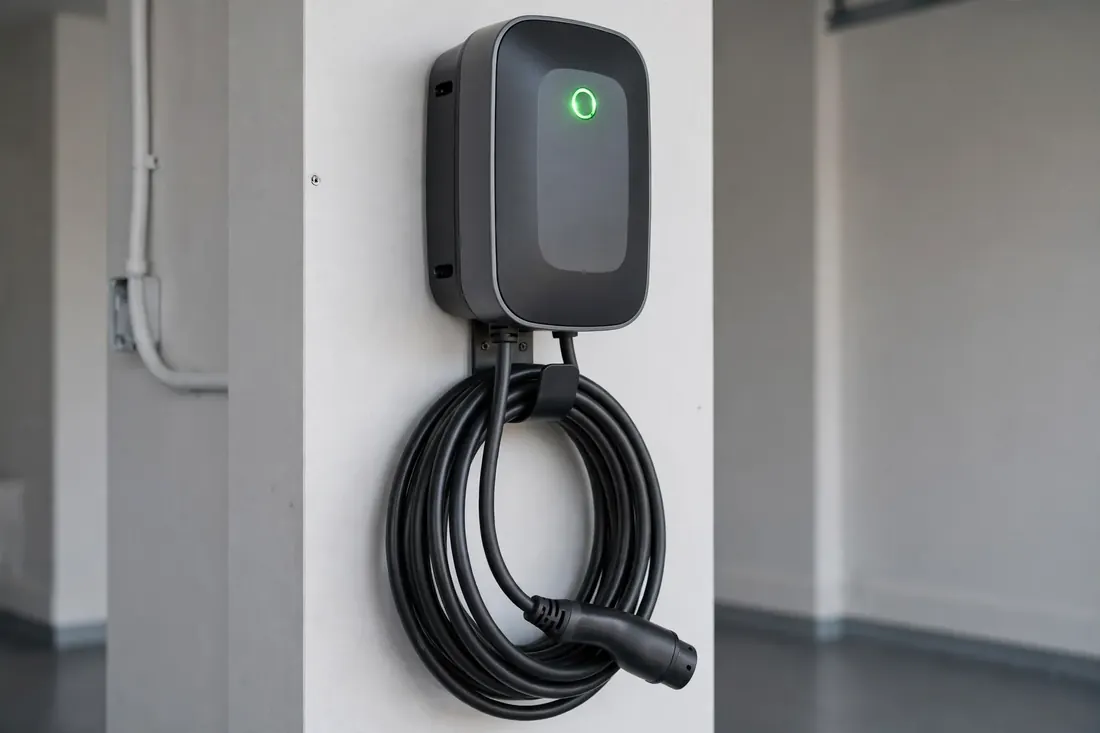
For a house with its own garage, the visit starts at the panel. Many newer homes in Doral, Kendall West and Cutler Bay already have a larger service with room for a new dedicated circuit near the garage. Older homes in Little Havana, Allapattah and parts of Hialeah may have smaller services, a panel on the opposite side of the house from the driveway, or a carport instead of an enclosed garage. The electrician runs a load calculation, measures the distance to the parking spot, and decides whether the station should be hardwired or plugged into a new heavy-duty receptacle built for continuous charging.
Hardwired mounting is common outdoors because it removes a connection point that heat and moisture can attack, and it supports higher charging rates. A plug-in setup can make sense inside a garage when you want to remove the unit more easily later. Either way, the connector should hang where the cable reaches the car port without crossing a walkway under tension, and the station should sit high enough to stay clear of wash water and low enough to use without a step.
That sequence — panel math first, mounting second, inspection last — is what home ev charger installation Miami houses need to pass on the first visit. If the panel cannot carry the new load, the choices mirror those in other cities — upgrade the service, add capacity, or use listed load management — with one Miami addition: panel work in a flood area may also need elevation. Get the load math, the permit office and the mounting height settled in one plan, so the inspection passes without a second round of changes.
How should hotels, workplaces and multifamily owners think about shared charging?
Commercial ev charging Miami property owners ask about usually serves three groups at once: guests who stay one night, employees who stay all day, and residents who stay every night. Those dwell times point to Level 2 as the workhorse for lots and garages, with faster charging reserved for highway-facing or high-turnover sites. Networked Level 2 stations let a property limit use to residents or guests, track energy by driver, recover electricity costs and get alerts when a unit needs service, which matters when a hotel engineer, not the driver, owns the problem.
FPL supports part of that build through its EVolution Make-Ready Credit program for qualifying business, multifamily and fleet sites. The credit helps with the behind-the-meter infrastructure that makes charging possible — service work, transformers, conduit, wiring and related electrical upgrades — while the property still buys and installs its own charging equipment and covers ongoing upkeep. Level 2 projects for public, workplace, fleet and multifamily use and larger fast-charging projects are covered under different credit tiers, and funding is first-come, first-served until the budget is used. Confirm current funding on the FPL program page before you design a budget around it.
One state change matters for planning. Since July 2024, regulation of charging stations in Florida is handled at the state level through the Department of Agriculture and Consumer Services, and local charging mandates that once applied to new development can no longer be enforced the same way. Building and electrical permits are still required. Design the electrical capacity first, phase the number of stations, and leave conduit room to grow, because adding capacity later in a finished garage costs far more than oversizing the pathways on day one.
What fails first on a Miami charger, and when should you book a repair?
Heat, moisture and corrosion set the repair list here. Owners call about a station that faults only in the afternoon, a connector that shows green corrosion at the pins, a breaker that trips after heavy rain, or a cable jacket stiffened and cracked by sun. In a condo deck, the clue may be shared: several stations on one system fault together after a building outage, which points to the network or the shared supply rather than to one car.
Do a short, safe triage before you book ev charger repair Miami service. Note whether the car charges at a public station, whether the fault follows rain or heat, and whether the station lights show a ground-fault or temperature warning. Photograph any visible corrosion or water marks without opening the enclosure. Then stop using a station that shows scorching, melting, a burning smell or repeated breaker trips, and leave the breaker off until it is checked.
A proper repair checks terminations for corrosion and tightness, tests ground-fault protection, confirms the circuit is still sized for the station setting, and looks for water paths into boxes and conduit. In coastal homes, the fix often includes replacing ordinary hardware with corrosion-resistant parts so the same failure does not return next season. If storm surge reached the unit, replacement is often the safe answer rather than drying the unit and hoping. For a new install or a repair diagnosis, Call Now.
Level 1 vs Level 2 Charging: Which Fits Your Life?
A condo owner deciding between plugging into a lobby outlet and installing a real station faces the same trade-off as a homeowner, only with board rules and longer nights in a shared garage. Here is the honest split.
- Plugs into an existing 120-volt outlet, so it can start the day you bring the car home.
- Adds a few miles of range per hour, which may cover a short hop to work or school.
- In a condo garage it still needs board permission to use common electricity, and billing is hard to track fairly.
- Slow speed means the car may sit plugged in around the clock, tying up your space and cable.
- Runs on a permitted, dedicated 240-volt circuit sized for continuous charging.
- Restores a full day of Miami driving in one overnight session in your own space.
- Supports separate metering, which Florida condo law requires for a private station.
- Pairs with networked billing and load sharing when a building adds stations for many residents.
EV Charger Services in Miami, FL
Also Serving Drivers in Nearby Metros
Driving between metros? These nearby city guides follow the same research standard:
EV Charger Installation in TampaEV Charger Installation in AtlantaEV Charger Installation in Charlotte