First, Sort the Symptom Into the Right Family
Technicians begin by grouping the symptom. No lights at all points toward supply: a tripped breaker, a tripped ground-fault device, or a lost connection upstream. Lights on but no charging points toward communication: the connector not latching, a vehicle schedule holding the session, or a handshake fault between car and unit. Charging that starts then stops points toward heat, ground-fault protection, or a supply problem that appears under load.
Write down what you observe before resetting anything. Note the light colour and pattern, any code or message in the app or the car, the weather, and how long the session ran before stopping. Fault blink patterns have meanings in the manufacturer manual, and a technician can do far more with your notes than with a report that the charger acted strangely.
Try the same car on a different charger, or a different car on yours, if that is practical. That single swap halves the diagnostic tree. Public charging working normally tells you the car is likely fine and the home chain deserves the attention.
No Power: Breakers, Ground Faults, and Supply Checks
A dead unit most often traces to its breaker. Find the charging breaker in your panel and check whether it sits in the tripped middle position. Reset it once by switching fully off, then on. If it trips again immediately, or trips as soon as charging starts, stop resetting it. A breaker that will not hold is reporting a fault, not being stubborn.
Ground-fault protection is the second common cause. Plug-in units on protected receptacles can trip the receptacle or a GFCI breaker, sometimes due to moisture, sometimes due to interaction between the equipment protection and the circuit protection. Note the weather and whether the trip follows rain, which helps the technician separate a genuine ground fault from nuisance tripping.
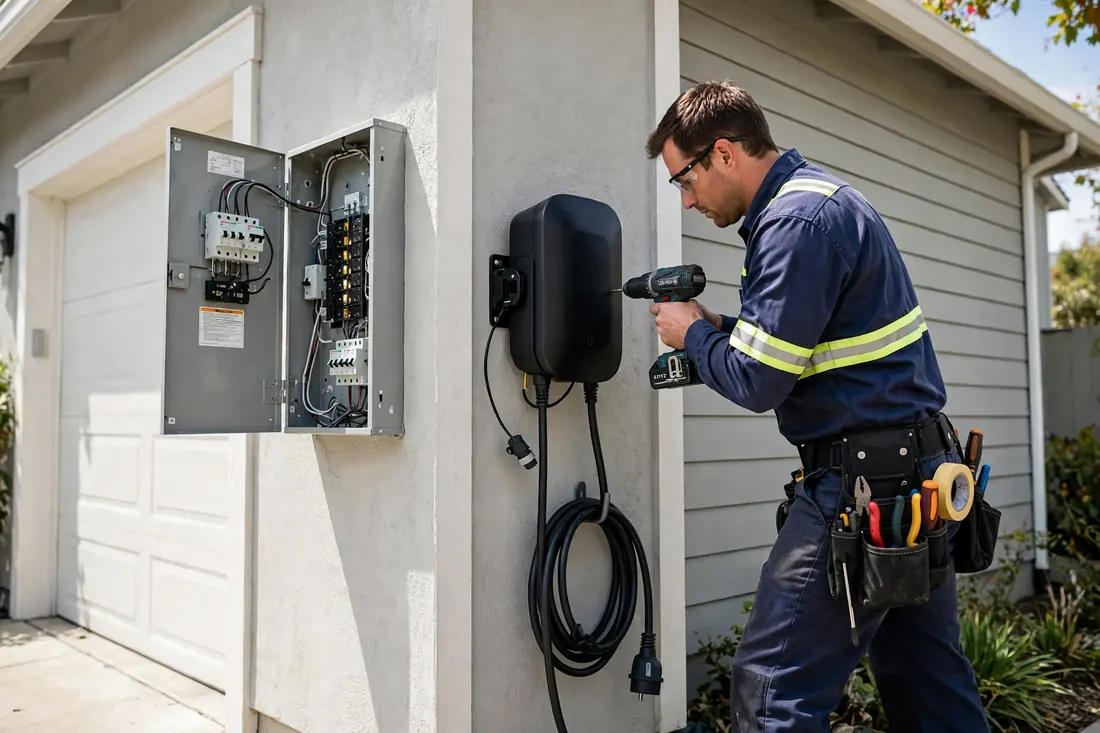
Safe owner checks end at observation and one reset. Opening the charger, testing terminals, or working inside the panel belongs to a licensed electrician. A 240-volt circuit at these currents can cause serious harm, and fault-finding inside live equipment is professional work.
Fault Lights, Blink Codes, and What They Usually Mean
A steady or blinking red light is the unit asking for attention in its own language. Common meanings across brands include a ground fault detected, an internal self-test failure, a stuck relay, overheating, or a communication error with the vehicle. The exact pattern differs by model, so the manual or the maker support page for your unit is the dictionary.
Power cycling helps with a narrow set of problems. Switching the breaker off for a full minute and back on clears some temporary software and sensor states, and owner reports suggest many one-off faults never return after a clean restart. If the same code returns within a few sessions, record it and book service rather than cycling repeatedly.
Firmware plays a role in smart units. An outdated unit that suddenly misbehaves after a vehicle software update may need its own update, applied through its app. Check for updates as part of basic troubleshooting, and mention any recent changes to the car, the home network, or the electrical system when you call for ev charger repair.
Cables and Connectors: The Wear Items Nobody Inspects
The cable and connector handle daily mechanical abuse: bending, coiling, occasional tire contact, driveway grit, and weather. Symptoms of wear include a latch that no longer clicks firmly, a connector that feels loose in the port, visible cuts or flattening in the cable jacket, and sessions that stop when the cable moves.
Inspect visually with the power off at the breaker. Look along the full cable length, check the connector pins for dirt or damage, and examine the point where the cable enters both the unit and the connector, where flexing concentrates. Grit inside the connector can be brushed out gently when dry; damaged pins or a cracked housing cannot be repaired at home.
Cable or connector damage usually means replacing the cable assembly where the design allows, or the whole unit where it does not. A technician can confirm which construction your model uses. Driving over a cable once may do no visible harm, but repeated crushing breaks internal conductors slowly, so reroute storage if the cable crosses a tire path.
Slow Charging and Sessions That Stop Early
A charger delivering half its usual speed has a short list of likely causes. The vehicle may be limiting charge because the battery is nearly full, cold, or hot, behaviour that is normal protection rather than failure. The unit may have been set to a lower output during installation or by a load management system responding to other house loads. Or the car own settings may cap the rate.
Sessions stopping early share some causes with tripping but add thermal behaviour. A unit in direct afternoon sun, a garage that traps heat, or a connector with worn contacts heating under load can all trigger protective shutdowns that reset after cooling. If stops cluster in hot weather or at the same session length, tell the technician; that pattern is diagnostic gold.
Compare against a baseline. Note the rate your car reports at a similar battery level on a public Level 2 charger. If public charging is normal and home charging is slow at the same conditions, the home equipment or its settings own the problem, and your repair visit can start there.

Heat, Smells, and Scorch Marks: Stop Conditions
Some findings end all troubleshooting. Discoloration or melting around a plug or receptacle, a hot smell during charging, buzzing from the panel, a breaker too hot to touch comfortably, or visible scorching anywhere in the chain means stop using the charger and call an electrician promptly. These are signs of a failing connection generating heat under sustained load.
Receptacle wear is a recognised version of this problem on plug-in setups. A receptacle that has loosened over years of plug cycles can overheat at charging currents even though it worked fine for lighter loads. Replacement with a heavy-duty unit rated for sustained service, installed and torqued correctly, is the standard remedy.
Do not continue charging at a reduced setting to get through the week after seeing heat damage. The fault is physical, not electronic, and lower current only slows the deterioration. Keep the breaker off until the visit if the damage is at your charger or its outlet.
Car-Side Causes That Imitate Charger Failure
Not every failed session is an ev charger repair case. Vehicle charge timers are the most common impostor: many cars hold charging until a scheduled departure or off-peak window, showing connected but idle while the charger waits correctly. Check the car app and dashboard settings before assuming the wall unit failed.
A weak 12-volt auxiliary battery in the vehicle can also prevent the car from waking to charge or from maintaining the session, a cause owners often miss because the main battery reads fine. Intermittent behaviour across different chargers points toward the vehicle. So does a fault that follows the car to public stations.
Port problems on the vehicle, such as a damaged latch mechanism or debris in the inlet, complete the car-side list. A technician visit that finds a healthy charger and a car-side cause is still a useful visit, because it sends you to the right repair instead of replacing good equipment.
Repair or Replace: The Decision Framework
With the fault identified, the repair-versus-replacement choice rests on five factors. First, safety: faults involving heat damage to wiring, receptacles, or the panel are repaired at the electrical level regardless of the charger age. Second, parts: some units have replaceable cables, contactors, or boards, while sealed units offer no internal parts path.
Third, age and support: a unit whose maker no longer supplies parts or firmware updates carries growing risk even after a successful repair. Fourth, the electrical context: if your panel or circuit needs work anyway, replacing the unit at the same visit can be the efficient path. Fifth, changed needs: a second vehicle, a longer commute, or a car with a larger onboard charger may justify replacement with higher or shareable output.
Ask the technician to state the fault, the part involved, and whether the same failure could recur. A repair with a named cause and an available part is very different from an unexplained reset. Get the diagnosis in writing either way, since it informs warranty claims and future service.
After Replacement: Making the New Unit Last
A replacement unit deserves the same permitted, inspected installation as a first one, including confirmation that the circuit capacity matches the new equipment settings. Do not assume the old circuit suits a higher-output model. The installer should recheck the load calculation if output rises.
Register the new equipment, save its manual and your permit paperwork together, and note the breaker location on the unit or its paperwork. Set up any app or scheduling at the commissioning visit, and run a supervised first charge before the installer leaves.
Then adopt the inspection habit that catches most problems early: a monthly glance at the cable, connector, and receptacle or unit face, plus attention to any change in sounds, smells, or session behaviour. Readers comparing cities will find local service notes under ev charger installation in Chicago and similar pages, but the troubleshooting order on this page applies everywhere: observe, sort the symptom, respect the stop signs, then Call Now.
If the old unit failed early, ask the installer to say plainly whether the cause was the equipment, the circuit, or the environment, and to correct the external cause during the replacement visit. A new charger installed onto a worn receptacle, a marginal breaker, or a sun-exposed wall without shade will inherit the same stress that shortened the life of the unit it replaced.
Reading Intermittent Faults: Pattern Diagnosis That Works
Intermittent faults surrender to patterns, not to single observations. The first pattern to test is time of day. A charger that fails only during the early evening, when cooking, laundry, and heating overlap, is pointing at the supply side or at a load management interaction. The same failure at random hours points elsewhere. Your two-week log from the earlier section is what makes this pattern visible instead of arguable.
The second pattern is session position. A unit that stops in the first minutes is failing a start-up check: connector seating, vehicle handshake, or a ground-fault test at session start. A unit that runs for hours and stops near the end of a session is more often heat-related, because every connection and component reaches its working temperature late in a long session. Note whether the car was nearly full when the session ended, since vehicles taper their charge rate near full and some apparent cut-offs are simply the car finishing early.
The third pattern is environment. Failures that follow rain suggest moisture reaching a connection, a damaged cable jacket, or drainage pooling at an outdoor unit. Failures on the hottest afternoons suggest thermal protection doing its work in an exposed location. Failures after a vehicle software update suggest a communication change between car and charger rather than an electrical defect at all.
Bring these three patterns, time, session position, and environment, to your service call. A technician hearing that the unit stops ninety minutes into evening sessions on hot days has a short, testable list. A technician hearing only that it sometimes stops has a long one. Pattern notes are the cheapest diagnostic tool in this entire guide, and they cost nothing but attention.
Intermittent Faults: The Hardest Problems to Pin Down
A charger that fails every night is, paradoxically, easier to fix than one that fails twice a month. Intermittent faults hide between visits, behave perfectly while a technician watches, and return the following week. The cure is evidence. Keep a simple log for two weeks noting the date, the time charging started, the battery level, the weather, what else was running in the house, and exactly what the unit displayed when it stopped.
Patterns in that log point at causes. Failures only during the evening cooking peak suggest a supply or load management interaction. Failures only after rain suggest moisture at a connection or in the connector. Failures at a similar session length suggest heat building somewhere in the chain. Each pattern hands the technician a different first test, which shortens the visit and raises the chance of a first-time fix.
Photograph fault displays before resetting anything, because many codes clear when power cycles and take their evidence with them. If your unit reports through an app, screenshot the session history for the failing nights. Owners who arrive at a service visit with a log, photographs, and screenshots routinely get a diagnosis in one visit that might otherwise take three.
Find EV Charger Repair & Replacement Near You
Local permit rules, utility programs and housing stock change how this work gets done. Pick your metro for a guide researched for your city:
- EV charger installation in Los Angeles, CA
- EV charger installation in Houston, TX
- EV charger installation in Phoenix, AZ
- EV charger installation in Atlanta, GA
- EV charger installation in Miami, FL
- EV charger installation in Dallas, TX
- EV charger installation in Austin, TX
- EV charger installation in Seattle, WA
- EV charger installation in Denver, CO
- EV charger installation in San Diego, CA
- EV charger installation in Chicago, IL
- EV charger installation in Las Vegas, NV
- EV charger installation in Charlotte, NC
- EV charger installation in Tampa, FL
- EV charger installation in Portland, OR