Heat first: what 110-degree summers do to charging
Start with the garage itself. On a peak summer afternoon, an unconditioned Phoenix garage commonly sits well above 100 degrees inside, and a car that rolls in after a freeway drive brings a hot battery with it. EVs manage that heat with fans and cooling systems, and many will charge more slowly while the pack is hot, then speed up as it cools. Owners sometimes read that slower start as a broken charger. Usually it is the car protecting itself, and it is one reason overnight charging suits this city so well: by midnight the garage, the car, and the grid have all cooled down.
Heat also ages the small parts. Plug connections cycle thousands of times over the life of a charger, and a connection that runs warm in a mild climate runs warmer here. Dust is the second enemy. Valley dust works into vents, filters, and fans, and monsoon season adds wind-driven moisture and the occasional Haboob-level grime event. Chargers rated for outdoor and dusty locations, mounted with some shade and airflow, hold up visibly better than bargain units baked on a south-facing wall.
Practical habits help as much as hardware. Charge to the level your daily driving needs rather than topping to full every night in the hottest months, use the car scheduling so charging finishes near departure instead of sitting full and hot for hours, and precondition the cabin while still plugged in on summer mornings. None of this requires special equipment. It requires an install designed with the climate in the room, which is exactly what the next sections cover.
Hardwired or plug-in? The desert changes the answer
Everywhere else in the country, hardwired versus plug-in is mostly a debate about convenience. In Phoenix it is also a debate about heat at a single point of contact. A plug-in charger draws its current through a receptacle and plug blades. That interface is a known warm spot under continuous load, and local installers who work in Arizona heat will tell you they see more heat stress at plug connections here than anywhere else in the system. It is why so many Valley electricians call hardwired the standard choice for this climate: one less connection to heat up, loosen, or collect dust.
A hardwired install also supports the higher charging settings some cars can use, since the largest plug-in setups top out below what a direct-wired circuit can deliver. If your car and panel support a higher setting, hardwiring is how you get it. The trade-off is flexibility. A hardwired charger stays with the house when you move, while a plug-in unit unplugs and travels with you.
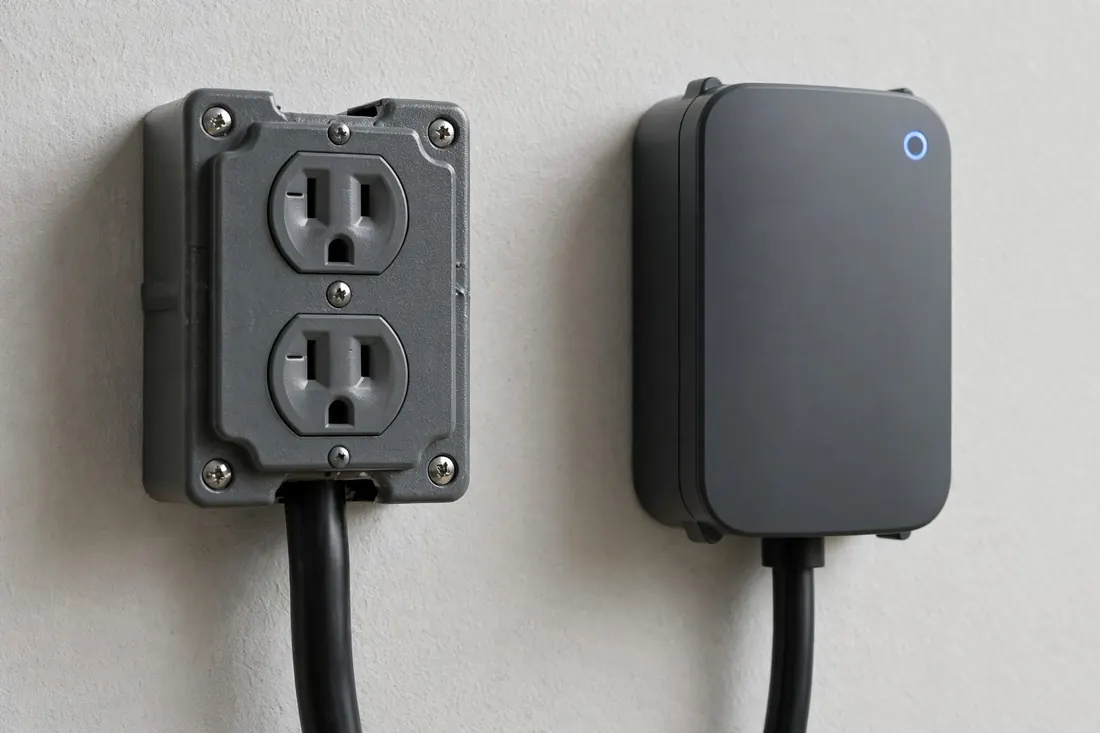
If you do choose plug-in, treat the receptacle as a wear part, not a commodity. It should be an industrial-grade unit made for continuous EV duty, installed on its own dedicated circuit with the ground-fault protection the current code requires for garage receptacles. Budget receptacles sold for a range or dryer that runs an hour at a time are the wrong part for a load that runs all night, every night, in a hot garage. Ask your installer, in so many words, which grade of receptacle is in the quote. The answer tells you a lot about the rest of the job. For ev charger repair in Phoenix, overheated receptacles and plugs are near the top of the call list every summer, and most of those repairs end with a hardwired replacement.
APS or SRP? Your address picks your rebate and your program
Greater Phoenix is split between two utilities, and the line matters more than the city limit sign. Arizona Public Service serves most of North and West Phoenix, downtown, and communities like Anthem, Surprise, Goodyear, and much of Scottsdale north area. Salt River Project serves much of the East Valley, including most of Mesa, Chandler, Gilbert, and Tempe, plus parts of east and south Phoenix and the Arcadia area. Some neighborhoods surprise people, so confirm your utility from your bill before you shop for programs.
If APS serves your home
APS offers a rebate on qualifying Level 2 smart chargers purchased through its marketplace, which helps with the equipment side of the project rather than the electrician labor. APS also runs SmartCharge, a program that rewards participation with an enrollment bill credit and ongoing monthly credits, in exchange for sharing charging data or allowing limited charging adjustments during high-demand periods. For a desert city where summer grid peaks are serious business, that trade is the utility paying you a little to help it learn and smooth the evening peak.
If SRP serves your home
SRP offers its own rebate toward a Level 2 charger bought through the SRP Marketplace, and an EV Community that gives a bill credit for joining and sharing in managed charging efforts. SRP also maintains a dedicated EV price plan option for households whose charging can run on the utility preferred schedule. On the business side, SRP runs a separate commercial charging rebate program with its own application windows and pre-approval steps, which matters for the workplaces section below.
Arizona has no statewide residential charger rebate, so these utility programs are the whole game for most Phoenix homeowners. Program terms, eligible charger lists, and enrollment windows change, so verify yours on the APS or SRP site the week you plan to buy, and keep purchase records matched to the program rules.
Timing is money: charging around APS and SRP peak hours
Both Valley utilities price electricity by the clock, and summer afternoons are when the clock gets expensive. APS residential time-of-use plans put the weekday on-peak window in the late afternoon, roughly the 4 p.m. to 7 p.m. stretch, when everyone arrives home and air conditioners are working hardest. SRP summer peak hours run longer, across the afternoon into the evening, roughly 2 p.m. to 8 p.m. on weekdays. Exact hours and rates belong to your specific plan, and both utilities adjust them over time, so treat these as the shape of the day and confirm the numbers on your bill.
The charging strategy writes itself. Plug in when you get home if you like, but set the car or charger to actually draw power after the peak window closes. You get three wins at once: lower-rate energy, a cooler garage and battery for the charging session, and no competition with your own air conditioner during the hours your home draws the most. On APS plans with a demand component, there is a fourth win: the demand charge keys off your highest usage hour during peak time, and an EV starting its charge inside that window can set your demand for the whole month. Scheduling is not a nicety on those plans. It is the plan.
Weekends and holidays sit off-peak on these schedules, which suits Saturday errands and Sunday top-ups. Winter flips part of the picture: APS offers a super off-peak midday window in the cooler months, when solar generation is strong and demand is low, which can make late-morning charging the smart slot from roughly November through April. A good installer will ask which plan you are on, or help you compare, before deciding where the charger settings land. Home ev charger installation in Phoenix that ignores your rate plan is only half an installation.
Permits in the Valley: Phoenix, the suburbs, and the county
A new 240-volt circuit for a charger needs an electrical permit and a final inspection in Phoenix, as it does in virtually every Valley city. Inside Phoenix, permits run through the city Planning and Development Department, and the work must meet the National Electrical Code standards for EV charging, including the dedicated circuit and the load calculation that proves your service can carry the new load. Licensed contractors typically handle the application, the install, and the inspection scheduling as one flow.
The Valley is a set of neighboring jurisdictions, each with its own counter:
- Phoenix: city permit and inspection through Planning and Development.
- Tempe, Mesa, Chandler, Gilbert, Scottsdale, Glendale, Peoria, Surprise: each city issues its own electrical permits, with its own forms and timelines.
- Unincorporated Maricopa County: county planning and development handles permitting for addresses outside city limits.
Two Phoenix details deserve emphasis. First, service work: if the project grows to include a panel or service upgrade, the serving utility, APS or SRP, coordinates the disconnect and reconnect, and that scheduling step often drives the calendar more than the wiring does. Second, summer timing: permit and inspection queues and utility schedules all tighten in the months when every contractor in the Valley is also replacing air conditioners. If you want a charger before a July road trip, starting the paperwork in spring is not overplanning. It is how this city works.
Arizona HOAs: no state right-to-charge law, so paperwork wins
Here is the Arizona fact that national articles routinely get wrong. Unlike California, Arizona does not have a statewide right-to-charge statute for EV charging. State law protects solar devices in planned communities, but no equivalent protection covers a home charger. Arizona HOA guidance is blunt about the consequence: an association can enforce covenants that restrict or even prohibit private charging stations, and whether you may install one turns on your community CC&Rs and your board process. Anyone who tells you Arizona law promises you a charger has not read the Arizona position.
That sounds worse than daily life usually is. A charger inside your own garage, on your own meter, with no visible change outside, is a modest request, and many Valley associations handle it with a routine architectural application. The harder cases are shared condo parking, assigned carports fed from a common panel, and any install that trenches across common area. Those are engineering and billing questions as much as legal ones: whose power, whose meter, whose maintenance.
Give your board a packet that answers those questions before they ask:
- The licensed installer name and the city permit path for your address.
- A diagram of the circuit route and charger location, noting anything visible from common areas.
- How the electricity is metered to you, including a submeter plan if the feed comes from a shared panel.
- Insurance and responsibility for upkeep and any damage, stated in writing.
- For solar homes, how charging will be scheduled, if the board cares about peak demand on shared infrastructure.
Get the approval in writing and file it with your home records. In a state where the documents rule, the documents are your protection, and a clean approval also helps the next owner of your unit.
Solar homes, casitas, and carports: very Phoenix installs
Rooftop solar is everywhere in the Valley, and it changes the charging conversation in a pleasant way. A solar home generates most in the middle of the day, which collides with the usual advice to charge at night. The right answer depends on your plan. On plans where midday winter hours are super off-peak and export value is modest, charging the car while the roof is producing can be the smartest energy you use all day. In summer, when afternoon peaks are priced high and the house needs every watt for cooling, overnight charging usually still wins. Many solar owners land on a split habit: daytime charging in the mild months, overnight charging in the hot ones, all handled by the car schedule once it is set.
Detached structures are the other Phoenix specialty. Casitas, RV gates, side-yard parking, and carports instead of enclosed garages are normal here. A carport install needs a charger and fittings rated for outdoor exposure, a mounting position that keeps the unit out of direct afternoon sun where possible, and conduit protected against both UV and the occasional monsoon burst. An RV gate install often means a longer circuit run and a pedestal mount, which your installer should plan with the gate swing and cable reach in mind, because a charger you cannot comfortably reach is a charger you will resent.
Guest houses and casitas raise a metering point. If the charger will serve a casita on the same service, the load calculation has to count that building loads too. If it sits on its own service, the project may be simpler than it looks. Either way, bring the whole property picture to the first visit. Phoenix lots hide second panels, spa circuits, and workshop feeds that change the design.
Workplace and multifamily charging in a city that drives everywhere
Commercial ev charging in Phoenix carries a Valley twist: summer demand. A workplace that adds a row of chargers is adding load to a building whose air conditioning already peaks on the same afternoons, so commercial designs lean heavily on managed charging that spreads power across ports and across hours. Employers in the Camelback Corridor, Midtown, and the airport area also compete for staff who commute from every corner of the metro, and reliable daytime charging is a benefit those drivers actually use.
Money exists for the business side. SRP runs a business EV charging program that rebates Level 2 ports and fast charging sites for eligible customers, with larger support for multifamily, government, nonprofit, and school properties, plus help for prewiring in new construction. The program works on a fiscal-year cycle with application deadlines and pre-approval required above certain totals, so commercial projects should start with the program calendar, not with a hardware order. APS business customers should likewise ask about current commercial charging support before designing, since offerings change between program years.
Multifamily properties face the billing question first: shared chargers with driver accounts, assigned chargers on unit meters, or a hybrid. In Arizona, where no state law forces an association hand, properties that solve billing and parking rules early turn charging into an amenity that rents units. Properties that improvise usually end up with two chargers, six arguments, and a board resolution. A commercial installer who knows the SRP program paperwork and the city permit path can keep the project on the amenity side of that line.
Summer repair calls: what fails in the heat, and what to check
Repair season in Phoenix is June through September. The calls repeat because the physics repeats. Chargers that derate or pause on the hottest afternoons. Plugs and receptacles that run hot to the touch. Breakers that trip when the car and the air conditioner peak together. Units that fill with dust until a fan or vent struggles. And cars that charge slowly at first on summer nights while the battery cools itself, which worries owners but is usually the vehicle behaving correctly.
Sorting the car from the circuit is the first job of ev charger repair in Phoenix. A technician will check whether the slowdown follows the vehicle thermal pattern, measure the circuit under load, inspect the receptacle or hardwired terminations for heat damage, and look at ventilation and dust around the unit. Heat damage leaves evidence: discoloration at terminals, brittle insulation near connections, a receptacle face that has lost its spring grip on the plug. Those findings end arguments about whether a part needs replacing.
Prevention is mostly placement and grade. A shaded or interior wall position, an industrial-grade receptacle or a hardwired connection, clean vents, and charging scheduled into cooler hours all reduce summer stress. If you are searching for an ev charger installer near me because your current unit keeps faulting in August, ask the new installer to diagnose the whole circuit rather than quote a like-for-like swap. Replacing a heat-stressed charger while leaving a heat-stressed receptacle in the wall just books the same call for next summer. Ready to design an install that treats heat as the main character? Call Now. Comparing climates? See how the same project reads in Los Angeles or Las Vegas.
Level 1 vs Level 2 Charging: Which Fits Your Life?
In Phoenix, the Level 1 versus Level 2 question is really a question about summer nights and rate windows. Here is the comparison Valley drivers actually face.
- Runs on a standard outlet, so it avoids a new circuit and works as a short-term bridge
- Adds range slowly, which struggles to recover a cross-Valley commute before the next morning
- Long sessions put hours of continuous load on an ordinary circuit in a hot garage
- Gives you no practical way to target off-peak or super off-peak windows with a full charge
- Can fit a low-mileage driver with a short, steady route and patience in summer
- Dedicated 240-volt circuit, permitted and inspected, designed for continuous overnight loads
- Finishes charging inside the cooler, lower-rate hours instead of stretching across the whole day
- Hardwired installs remove the plug connection that heat stresses most in Phoenix garages
- Scheduling pairs with APS and SRP time-of-use plans, including winter midday super off-peak hours
- Keeps up with two-car households and long Valley commutes through the hottest months
EV Charger Services in Phoenix, AZ
Also Serving Drivers in Nearby Metros
Driving between metros? These nearby city guides follow the same research standard:
EV Charger Installation in Los AngelesEV Charger Installation in Las VegasEV Charger Installation in San Diego